
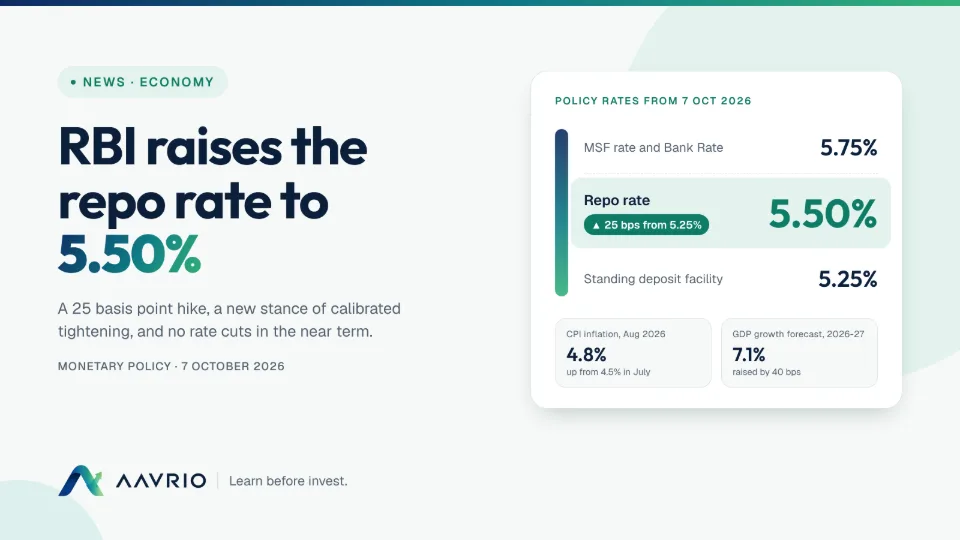
The Reserve Bank of India has raised the repo rate by 25 basis points to 5.50%. The Monetary Policy Committee voted unanimously for the hike on 7 October 2026 and said rate cuts are off the table in the near term.
The new rates
Repo rate: 5.50%, up from 5.25%
Standing deposit facility (SDF) rate: 5.25%
Marginal standing facility (MSF) rate and Bank Rate: 5.75%
The committee met from 5 to 7 October. It also changed its stance to "calibrated tightening". In the RBI's words, the next move can only be a hike or a pause, depending on how inflation and growth turn out.
Why the RBI raised rates
Prices are rising faster. CPI inflation went up to 4.8% in August from 4.5% in July, led by food and fuel. Onion prices rose about 85% between end-June and end-September, and sugar reached ₹64 a kilo by end-August. Core inflation, which leaves out food and fuel, climbed to 4.2%.
The RBI expects more pressure ahead. The southwest monsoon ended 13% below normal, and the Indian basket of crude oil averaged US$116.1 a barrel in September, up from US$82.0 in July, after the West Asia conflict flared up again. The RBI now projects CPI inflation at 5.2% for 2026-27, peaking at 6.0% in the October to December quarter.
Growth is holding up
India's GDP grew 7.8% in April to June 2026. The RBI raised its growth forecast for 2026-27 by 40 basis points to 7.1%. Bank credit grew 18.1% in the year to 15 September, against 10.4% a year earlier.
What a repo rate hike usually means for you
The repo rate is the rate at which the RBI lends to banks for short periods. When it goes up, banks usually pass some of the increase on to their customers over the following weeks and months.
If you have a floating-rate home loan or other loan linked to the repo rate, its interest rate typically rises at the next reset date in your loan agreement. Your lender then raises the EMI or stretches the tenure, so check which one it applied. Fixed-rate loans stay the same.
Banks may also raise fixed deposit rates, but each bank sets its own rates and timing. If you are opening a new FD, compare a few banks first.
Two other announcements
The RBI will let NBFC account aggregators work with each other, so one account aggregator can fetch your financial information through all of them. SEBI-regulated depositories will also be able to show your deposit accounts in the consolidated account statement (CAS). Both changes are due by 31 December 2026.
The RBI will also set up a Technical Consultative Committee for Financial Markets, a forum to consult market participants on policy.
Frequently asked questions
What is the RBI repo rate now?
5.50%, after a 25 basis point hike announced on 7 October 2026.
Will my home loan EMI go up?
If your loan has a floating rate linked to the repo rate, the rate usually rises at your next reset date. Your lender then raises the EMI or extends the tenure. Fixed-rate loans do not change.
What does "calibrated tightening" mean?
It is the RBI's signal that rate cuts are off the table for now. Its next move will be another hike or a pause, depending on inflation and growth.
This story is for education only and is not investment advice.