

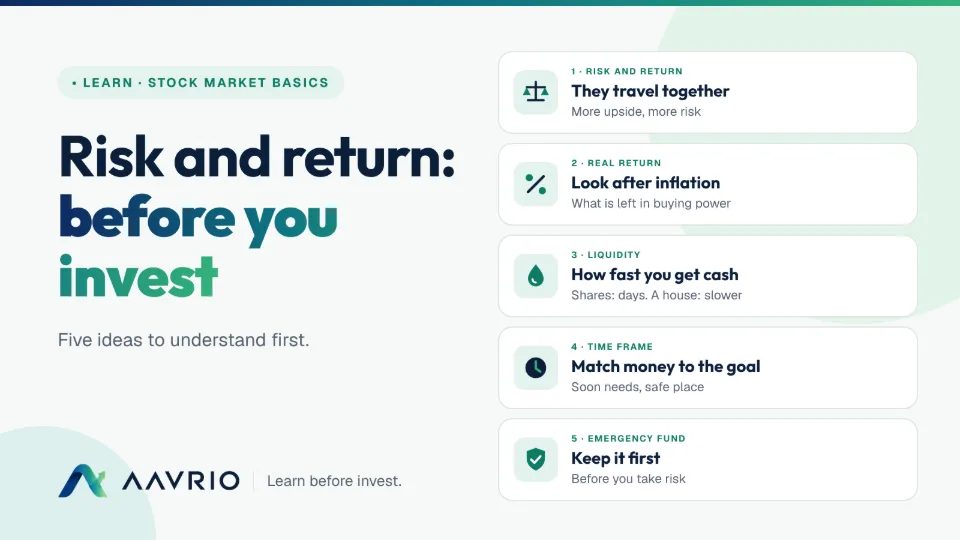
Every investment is a trade. You accept some risk in return for the chance of a gain. Five ideas make that trade easier to judge.
1. Risk and return travel together
Investments that can grow more usually can also fall more. A fixed deposit is calm because the rate is fixed. Shares can grow faster, but their prices move up and down. A promise of high returns with no risk is a warning sign.
2. Look at the return after inflation
If a deposit pays 7% and prices rise 6%, your money grew by only about 1% in buying power. That figure is called the real return. Always ask what is left after inflation.
3. Know how quickly you can get your money out
This is liquidity. Shares and mutual funds can usually be sold within a few days. A house cannot. Money you may need soon should sit where it is easy to withdraw.
4. Match the investment to the time you have
Money needed in one year should not sit in something that can fall sharply this year. Money for a goal twenty years away can sit through more ups and downs.
5. Keep an emergency fund first
Set aside a few months of expenses in a safe, easy place before you take investment risk. Then a sudden bill does not force you to sell at a bad time.
Also check that whoever handles your money is registered with the regulator. We look at that in the next module.
Check yourself
A deposit pays 7% while prices rise 6%. What is your real return?
Answer: About 1%, which is what is left in buying power.
Frequently asked questions
What is the relationship between risk and return?
In general, the more return an investment can offer, the more risk it carries. Low-risk options tend to offer lower returns.
What is liquidity?
It is how quickly and easily you can convert an investment into cash without losing much value.
How much emergency fund do I need?
A common guideline is three to six months of household expenses, including EMIs, kept somewhere easy to withdraw from.
This lesson is for education only and is not investment advice. Investments in securities are subject to market risks.