

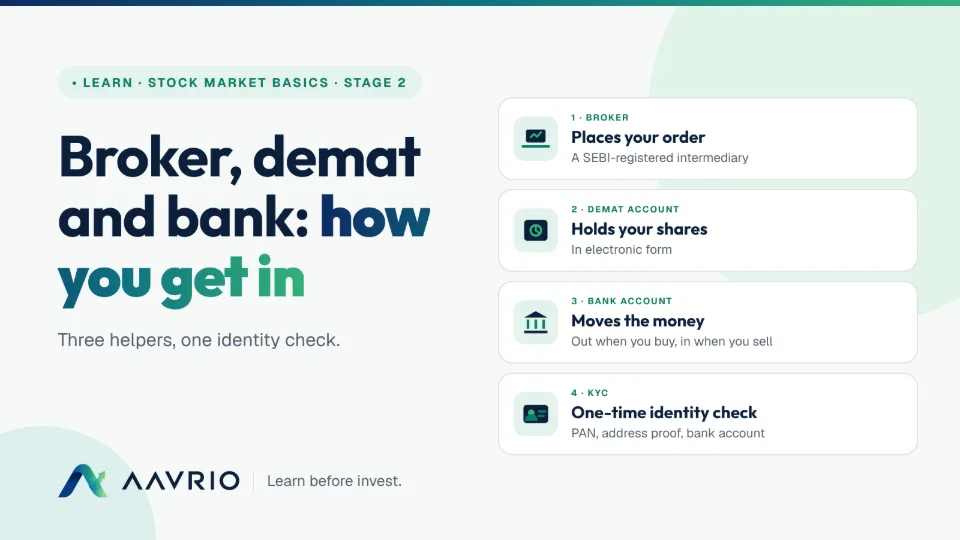
Buying a share involves three helpers, each with its own job. Once you see the three, the process stops feeling mysterious.
The stock broker
A broker is a registered intermediary. You tell the broker what you want to buy or sell, and the broker sends your order to the exchange. In return, the broker charges a fee for the service. Pick one that is registered with SEBI.
The demat account
"Demat" is short for dematerialised, which means held in electronic form. Years ago, shares were printed on paper certificates. Now they sit in a demat account, much like money sits in a bank account. The account is held with a depository through a depository participant, often your broker or bank. India has two depositories, NSDL and CDSL.
The bank account
Your bank account is linked to your trading account. When you buy, money goes out of it. When you sell, money comes back into it.
Putting it together
When you buy a share, the broker sends the order, the exchange matches it with a seller, the money leaves your bank account and the share lands in your demat account. You see all of it through your broker's app or website.
What you need to open them
You complete a one-time process called KYC (know your customer). It needs your PAN, an address proof and a bank account. Brokers can often do this online.
Check yourself
Which account holds your shares in electronic form?
Answer: the demat account.
Frequently asked questions
What is a demat account?
It is an account that holds your shares and other securities electronically, so no paper certificates are needed.
Are a trading account and a demat account the same?
No. The trading account lets you place orders. The demat account stores the shares you own. Most brokers open both together.
Do I need a PAN to invest?
Yes, a PAN is needed to complete KYC and start trading.
This lesson is for education only and is not investment advice. Investments in securities are subject to market risks.