
When you press buy, the price is agreed in a moment. But a trade is not finished until the shares and the money have both changed hands. That second step is called settlement, and clearing corporations manage it.
The problem they solve
Suppose you buy shares from a stranger you will never meet. How do you know they will really hand over the shares? And how do they know you will pay? Without a trusted middle party, few people would dare to trade.
The middle party
A clearing corporation sits between every buyer and seller on an exchange. It becomes the buyer to the seller and the seller to the buyer. If one side fails to deliver, the clearing corporation still makes sure the other side is made whole. In India, the NSE has NSE Clearing, and the BSE has the Indian Clearing Corporation.
What happens after your order
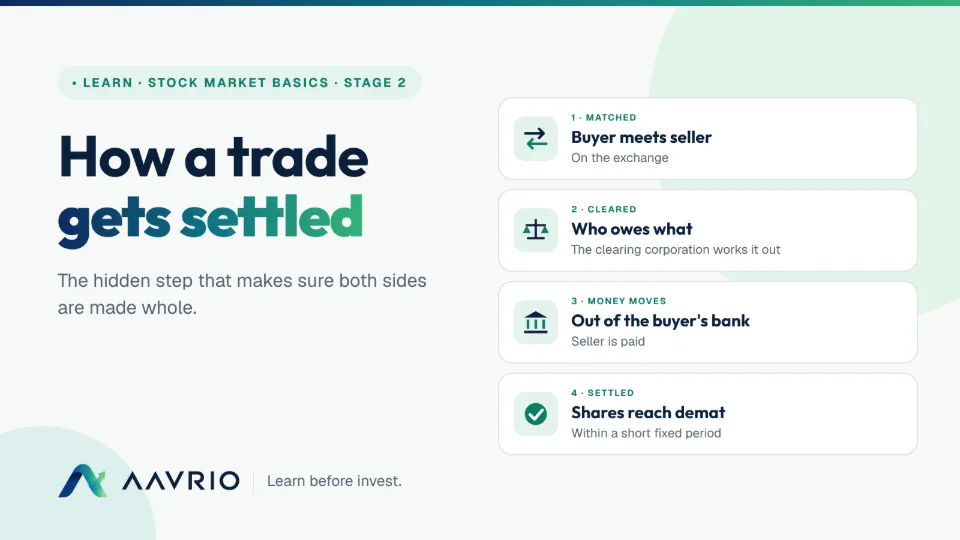
Your order is matched with a seller on the exchange.
The clearing corporation works out who owes what.
Money moves out of the buyer's bank account.
Shares move into the buyer's demat account, and the seller is paid.
This finishes within a short, fixed period after the trade, set by the exchanges. You do not have to chase anyone.
Next, we look at how companies get onto the market in the first place.
Check yourself
Who makes sure the buyer gets the shares and the seller gets the money?
Answer: the clearing corporation.
Frequently asked questions
What is settlement?
It is the final step of a trade, when the shares move to the buyer and the money moves to the seller.
What is a clearing corporation?
It is an organisation that guarantees and settles trades on an exchange, so that neither side has to trust the other directly.
Do I need to do anything for settlement?
No. Your broker and the clearing system handle it. You will see the shares in your demat account and the money in your bank account.
This lesson is for education only and is not investment advice. Investments in securities are subject to market risks.