

Say you buy a share and later sell it. Did you do well? One small formula answers that.
The simple return
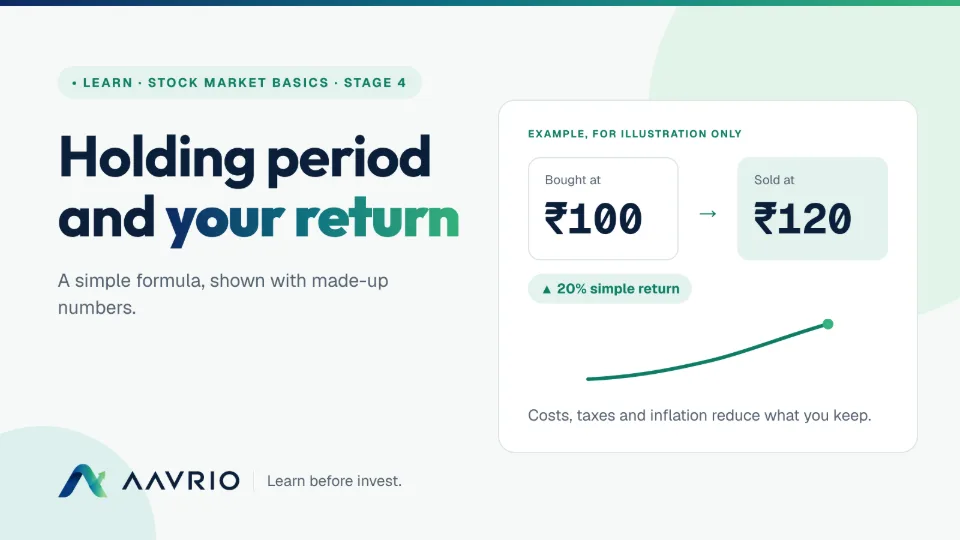
Return is the gain or loss as a share of what you paid. Take a made-up example: you buy a share at ₹100 and sell it at ₹120. The gain is ₹20. Divide ₹20 by ₹100 and you get 0.2, or 20%. If you sold at ₹90 instead, the loss is ₹10, so the return is minus 10%. These numbers are only to show the method.
Holding period
The holding period is the time between buying and selling. It matters in two ways. A 20% gain in one year is very different from a 20% gain in ten years, so always compare returns over the same period. And the holding period can change how a gain is taxed, so check the current rules before you sell.
What reduces your return
Broker charges and other fees on each trade.
Taxes on your gains.
Inflation, which lowers what the money can buy, as we saw in Stage 1.
So the number on your screen is not always the amount that stays with you.
Before the next stage
You now know how to follow a trade and measure a result. Next we look at how people read the market as a whole, using indices.
Check yourself
You buy at ₹50 and sell at ₹60. What is your simple return?
Answer: the gain is ₹10 on ₹50, which is 20%, before costs and taxes.
Frequently asked questions
How do I calculate the return on a share?
Subtract your buying price from your selling price, divide by your buying price and multiply by 100.
What is a holding period?
It is the length of time you hold a share between buying and selling it.
Do I pay tax on share gains?
Gains from shares are generally taxable, and the rules depend on how long you held them. Check the Income Tax Department's current rules or ask a registered professional.
This lesson is for education only and is not investment advice. Investments in securities are subject to market risks.