

Every month brings new numbers about the economy. You do not need to follow them all, but a few appear in most market stories.
Inflation
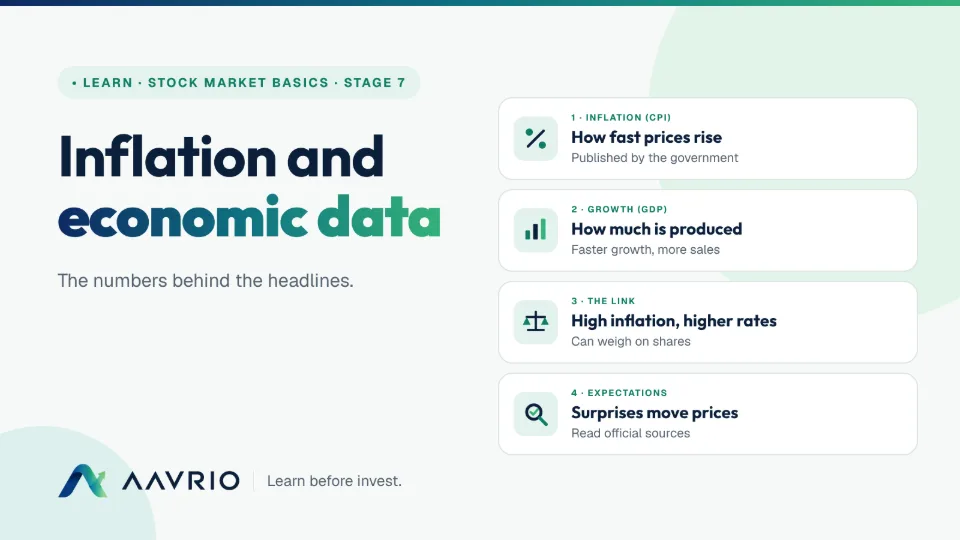
Inflation tells you how fast prices are rising. In India, the government publishes it regularly as an index of retail prices, often called CPI. You met inflation in Stage 1: it is the reason idle money buys less over time.
Economic growth
Growth, often measured as GDP, shows how much the economy has produced compared with before. A faster-growing economy usually means companies sell more.
How they link together
If inflation runs high, the RBI may raise interest rates to cool prices. Higher rates can slow borrowing and spending, which can weigh on companies and shares. If inflation is low and growth is healthy, the mood can be calmer.
Why expectations matter
Before each release, analysts publish their guesses. The market has already priced those guesses in, so a number moves prices mostly when it is better or worse than expected.
Where to find the figures
Read them from official sources, such as the government's statistics ministry and the RBI, rather than from social media summaries.
Check yourself
Why might high inflation lead the RBI to raise interest rates?
Answer: higher rates can slow spending and help cool rising prices.
Frequently asked questions
What is CPI?
The Consumer Price Index, a measure of how retail prices change over time.
What is GDP?
Gross domestic product, a measure of how much an economy produces.
Do I need to follow every release?
No. Understanding inflation, growth and interest rates is enough to follow most market news.
This lesson is for education only and is not investment advice. Investments in securities are subject to market risks.