

Imagine you own a pizza cut into 4 slices. If it is cut into 8 slices instead, you still own the same pizza. Bonus shares and splits work a little like that.
Bonus shares
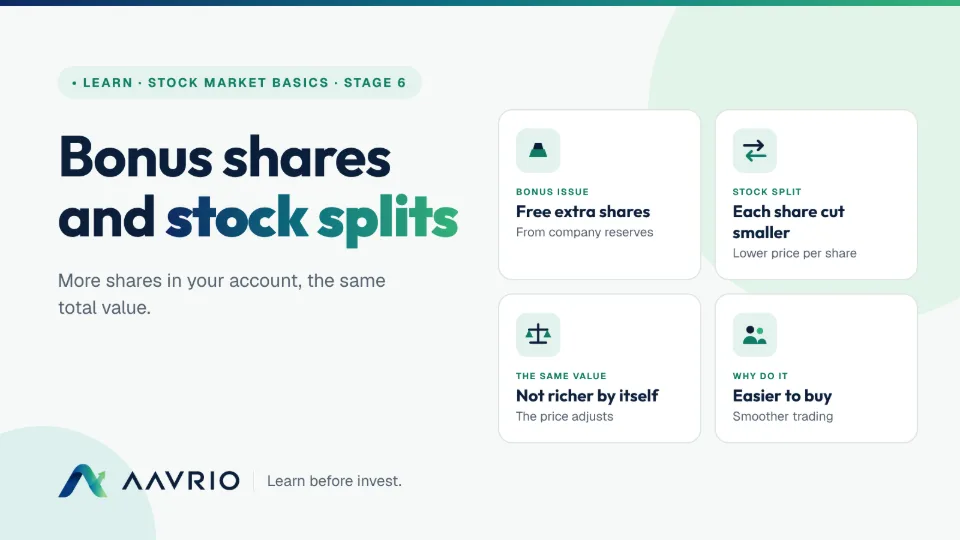
In a bonus issue, a company gives existing shareholders extra shares at no cost, in a ratio such as one extra share for every one held. It does this by turning some of its reserves into shares. You now hold more shares, and the price adjusts downward, so the total value of your holding does not change on its own.
Stock split
In a split, each share is divided into smaller ones. For example, one share becomes two. The number of shares you hold goes up and the price of each goes down in the same proportion. Again, the total value stays the same on that day.
The difference
A bonus issue gives extra shares from the company's reserves. A split cuts the existing shares into smaller pieces. Both leave the company's value unchanged at the moment they happen.
Why companies do it
A lower price per share can make the stock easier for small investors to buy.
More shares in circulation can make trading smoother.
A bonus issue can be a sign that the company has built up healthy reserves.
Check yourself
After a split, does the total value of your holding change just because of the split?
Answer: no. You hold more shares, each at a lower price.
Frequently asked questions
Do I pay for bonus shares?
No. They are given to existing shareholders at no cost.
Does a split make a share cheaper to own?
The price per share falls, but the value of what you own stays the same.
Where do the new shares go?
They are credited to your demat account after the company completes the process.
This lesson is for education only and is not investment advice. Investments in securities are subject to market risks.