
Picture a small bakery that does well. The owner wants a second shop, a bigger oven and more staff. All of that costs money the bakery does not have yet.
Where the money can come from
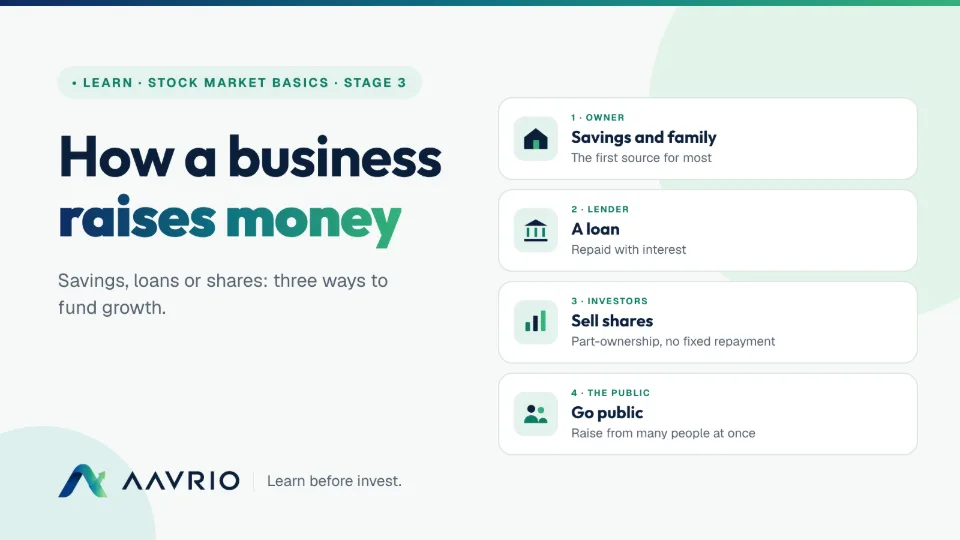
A business has a few usual sources:
The owner's own savings, or help from family and friends.
A loan from a bank or another lender.
Investors who put in money in return for a share of the business.
A loan versus a share
A loan is simple. The business borrows, pays interest and gives the money back. The lender does not own any part of the bakery.
A share works differently. An investor puts in money and becomes a part-owner. The business does not have to repay that money on a fixed date, but the investor now has a claim on future profits and a say in how the company is run.
Private and public
Most small businesses are private companies. Their shares are held by a few people, such as the founders and early investors, and ordinary people cannot buy them.
A public company has shares that anyone can buy and sell on an exchange. When a company grows large enough, it may choose to become public to raise a big amount from many investors at once. That step is called an IPO, and the next lesson explains it.
Why this matters to you
When you buy a share of a listed company, you are one of those part-owners. Knowing why companies sell shares helps you read the news with a clearer head.
Check yourself
What is the main difference between a lender and a shareholder?
Answer: a lender is repaid with interest and owns nothing. A shareholder owns part of the company.
Frequently asked questions
Why do companies sell shares instead of just taking loans?
A loan must be repaid with interest whether the business does well or not. Share money does not have to be repaid on a fixed date, though shareholders expect the business to grow.
What is a private company?
It is a company whose shares are held by a small group and are not traded on a stock exchange.
Can anyone start a public company?
A company usually grows as a private business first. It becomes public later, after meeting the rules set by the regulator and the exchange.
This lesson is for education only and is not investment advice. Investments in securities are subject to market risks.