

Going back to our bakery: after years of growth, the owner wants to open fifty shops. A bank loan will not cover it. So the owner decides to invite the public to become part-owners.
What an IPO is
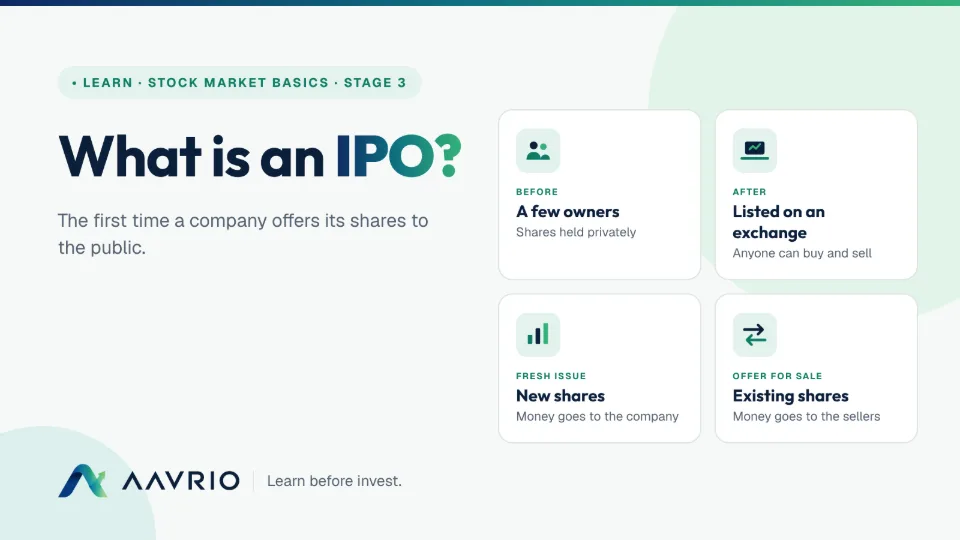
IPO stands for initial public offering. It is the first time a company sells its shares to the general public. Before it, only a few people own the company. After it, anyone can buy a share, and the company's shares are listed on an exchange.
Why companies do it
To raise money for growth, such as new plants, new products or paying off debt.
To let early investors and founders sell part of their holding.
To become better known, since a listed company is watched closely and must share regular reports.
Fresh issue and offer for sale
An IPO can have two parts. In a fresh issue, the company creates new shares and the money goes to the company. In an offer for sale, existing shareholders sell some of their shares and the money goes to them, not to the company. Many IPOs have both, so it is worth checking which is which.
What it means for you
An IPO gives you a chance to buy shares early, directly from the company's offer. It does not guarantee that the price will rise. Some listings do well and some do not, and a good story is not the same as a good business.
The next lesson walks through the steps and the words you will see in an IPO announcement.
Check yourself
In an offer for sale, does the money go to the company?
Answer: No. It goes to the existing shareholders who are selling.
Frequently asked questions
What does IPO stand for?
Initial public offering.
Is an IPO always a good investment?
No. An IPO is only a way for a company to sell shares. Whether the shares are a good buy depends on the business and the price.
What is the difference between a fresh issue and an offer for sale?
A fresh issue creates new shares and raises money for the company. An offer for sale lets existing owners sell their shares, so the money goes to them.
This lesson is for education only and is not investment advice. Investments in securities are subject to market risks.